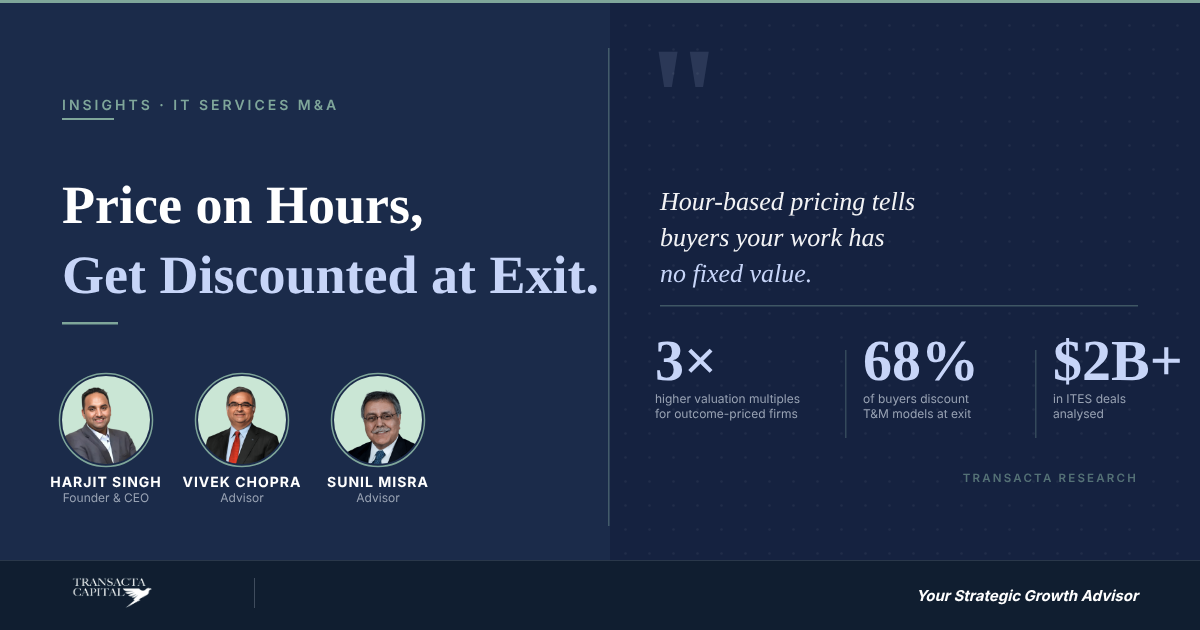
TCS hands 10 to 15% of its AI savings back to clients. Outcome pricing is still 3% of services revenue. What IT services and MSP founders should reprice before they sell, and test before they buy.
By Harjit Singh, Founder and CEO, Transacta Capital
Your pricing model now sets your exit multiple
This article is for founders of IT services firms and MSPs with $10 million to $500 million in revenue, whether you plan to sell in the next two years or buy your way to scale. AI is repricing your business from two directions at once. Your delivery costs may be falling, and your clients want the savings. In the MSP world your clients’ headcount is falling, and every per-user contract you hold shrinks with it.
The firms that move from billing effort to billing results will keep more of the margin that AI creates and your valuation will reflect that fact. The firms that keep billing effort or by headcount will hand that margin to clients, and buyers will value them accordingly. Over the next 24 months, the contract you sign with clients could matter more to your valuation than your revenue growth.
Hourly billing hands every AI gain to the client
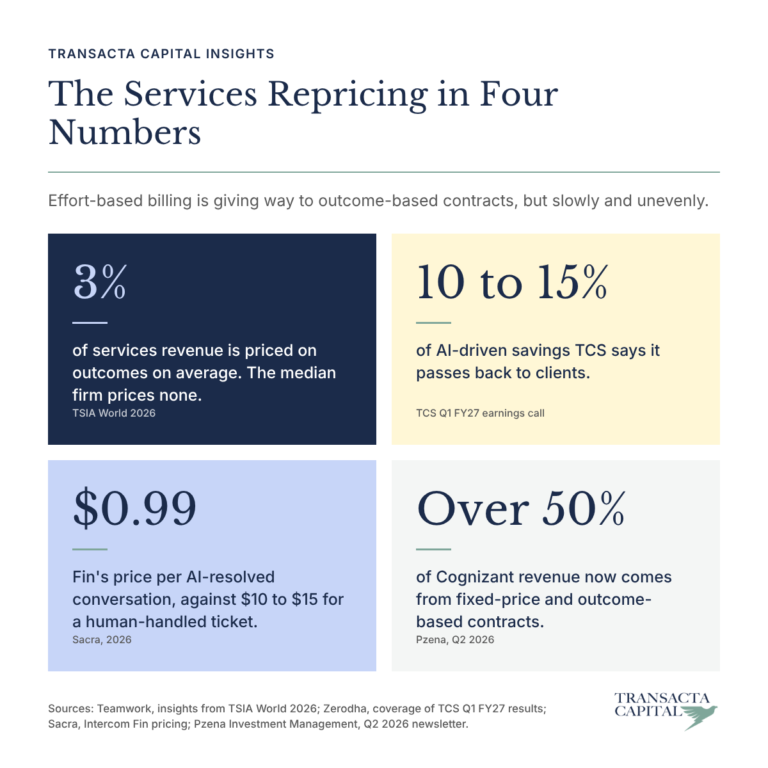
The arithmetic is simple. TSIA put it plainly at its 2026 conference: deliver 50% faster on a time-and-materials contract and you bill half the hours. TCS says it already passes 10 to 15% of AI-driven savings back to clients. ICICI Direct expects traditional IT services revenue to deflate 2 to 3% a year, and Infosys and HCLTech executives have said they walked away from AI-led contracts because the pricing no longer worked.
MSPs face the same squeeze through a different contract. Per-user pricing, typically $100 to $300 per user per month for small and mid-size clients, rides on client headcount. When a 200-person client automates its back office down to 140 people, the MSP loses 30% of that contract’s revenue while still running the same servers, endpoints and security stack. On the Business of Tech podcast, Rich Freeman described per-user MSP pricing as under strain for exactly this reason.
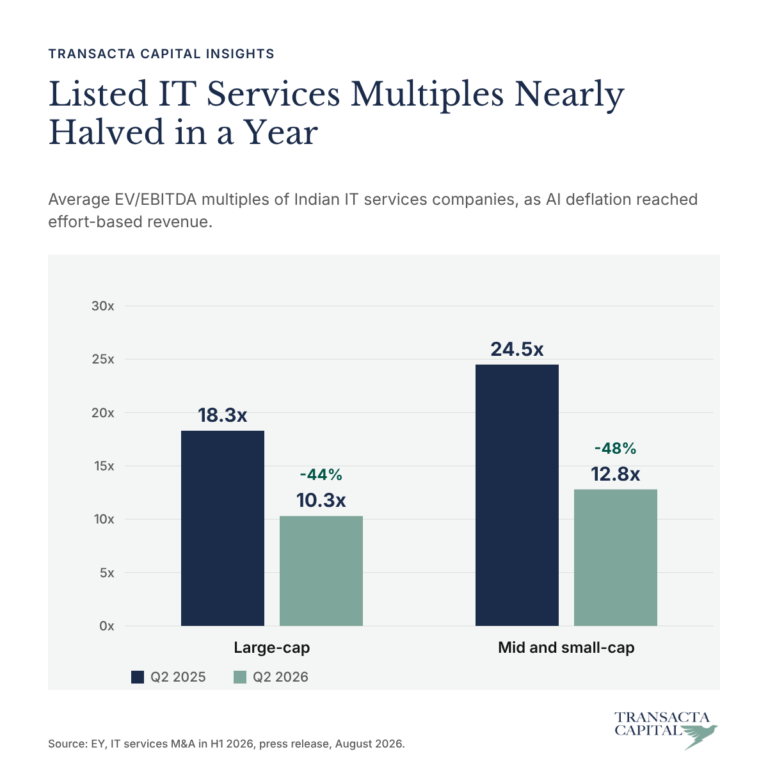
Public markets have already priced the risk. EY reports that EV/EBITDA multiples for Indian mid and small-cap IT services companies fell from 24.5x to 12.8x between Q2 2025 and Q2 2026, and large caps fell from 18.3x to 10.3x. Private buyers are splitting the market. Drake Star’s Q2 2026 MSP update says buyers now pay for AI proof over AI claims, and Solganick reports that firms without AI readiness or high-margin recurring revenue saw multiples stall while firms at the AI, cloud and security intersection moved toward 15x EBITDA and above.
ServiceNow shows how fast markets punish the old unit of charge
Our team started this conversation over a chart. On 28 October ServiceNow reported revenue up 20.5%, raised its outlook and lifted its AI contract value target to $1.7 billion. The next day its stock fell 26.9%, its steepest one-day fall in more than a year. Vivek’s response: the strongest vendors are already moving their pricing “from effort to outcome”.
IT services founders should read that chart as a preview. Software vendors charge per seat. You charge per hour, per FTE or per user. Each of those units measures effort, and AI is collapsing the effort needed for the same result. ServiceNow, with $4 billion a quarter in revenue, could not grow fast enough to make investors comfortable with its unit of charge. A $30 million services firm going to market with a time-and-materials book will get the same question from every buyer, at a smaller scale and with less room to answer it.
Outcome risk is token risk
Moving to outcome pricing means taking on a cost you have never had to forecast. Vivek put it directly:
“Though the headcount-to-outcome change is real, replacing five people with five agents is easier said than done. Five people in seats cost a fixed, known dollar value. Agents use up tokens, or computing power, every time they work on a ticket. That is the big unknown, because we have seen how easy it is for companies to lose control of their token usage if there are no guardrails, norms or governance defined. That is where humans in the loop will have their say and play a vital role.”
Vivek Chopra, Chairman, Mastek Inc.; Strategic Board Advisor, CygnusAlpha
For a services firm, this is the core underwriting problem. On a time-and-materials contract, the client pays for inefficiency. On an outcome contract, you do. If your agent loops on a ticket, retries a failed migration step or calls an expensive model for a simple lookup, the cost lands on your P&L and the client still pays only for the resolution. The 2026 data shows how easily that cost runs away:
– Research reported by ZDNet in May found agents using up to 3,500 times more tokens than simple prompts, and the same model using twice as many tokens on identical tasks.
– The FinOps Foundation found 73% of enterprises overshot their AI cost projections this year. Uber reportedly spent its full 2026 budget for AI coding tools in four months.
– Gartner expects more than 40% of agentic AI projects to be cancelled by the end of 2027, citing cost, unclear value and weak risk controls.
Klarna is the cautionary case. In early 2024 it said its AI assistant did the work of 700 customer service agents. A year later its CEO said the push for lower cost had lowered quality, and Klarna began hiring human agents again. A services firm that prices outcomes before it can govern agent cost and quality is taking the same risk with its own margin.
Our view: the governance Vivek describes is a service you can sell. Clients struggle to control agent spend. A firm that runs agents inside caps, budgets and human review, and reports cost per outcome monthly, is selling something clients cannot easily build themselves.
Clients want predictability first, and outcomes second
Outcome pricing is popular in conference talks and rare in contracts. TSIA’s 2026 data puts outcome-based pricing at 3% of services revenue on average, with a median of zero. ServiceNow’s management said on its October call that customers prefer a mix of fixed subscriptions and consumption pricing and are not asking for outcome-based pricing.
Futurum’s 2H 2026 survey explains why. Among enterprise buyers who rank pricing as a top criterion, per-seat pricing came last for core software, at 12.6%. For AI add-ons billed separately, the same buyers ranked per-seat first, at 42.3%. Buyers want flexibility where they understand the costs and a cap where they don’t. For an IT services firm, that points to a specific structure: a predictable base fee that covers the platform and the team, plus an outcome or volume component on the work AI now does. BCG names the hardest part. Vendors and clients struggle to agree on what counts as a completed job, so the definition has to be written down before the work starts.
Six pricing models for services, and what AI does to each
Client size changes what you should sell. Sunil described the large enterprise:
“I see a multi-hybrid approach developing, especially for larger enterprises, where core SaaS platforms will continue to occupy the prime spot on the architectural landscape. These systems of record are still needed. One reason is compliance and audit. Further, certain workflows need to be deterministic, which is hard to do with LLMs. Large software firms will also continue to embed certain types of inference capabilities in the core product.”
Sunil Misra, Executive Chairman, Bridgenext
For services firms serving large clients, the work moves from implementing and maintaining these platforms to wiring agents into them under audit and compliance rules. Vivek added that large SaaS platforms stay because of deep workflow embedding and API connections to dozens of other applications, which is integration work services firms already do.
Small clients are a different market. Vivek saw it first-hand:
“One of my advisory companies just replaced its HubSpot CRM with a brand-new, home-grown CRM, built in only three weeks. I saw a demo yesterday and was blown away. It is the size of the enterprise using the SaaS product that will decide whether to stay or go the customized, home-grown way.”
Vivek Chopra
Pax8’s Q3 2026 survey found 67% of small and mid-sized businesses using AI had built at least one AI tool now in regular use, and 35% had discovered AI tools nobody approved. MIT’s NANDA initiative found internally built AI systems succeeded about a third of the time, against two-thirds for tools bought from vendors. Sunil’s filter applies: “If it is easy to replace but gives no value, then it’s just a science project.”
For MSPs, that is the opening. Small clients are building software they cannot secure, maintain or govern. An MSP that inventories, secures and supports client-built AI tools, and prices that work per application or per workflow, has a new revenue line that grows as client headcount shrinks.
If you plan to sell: reprice before you go to market
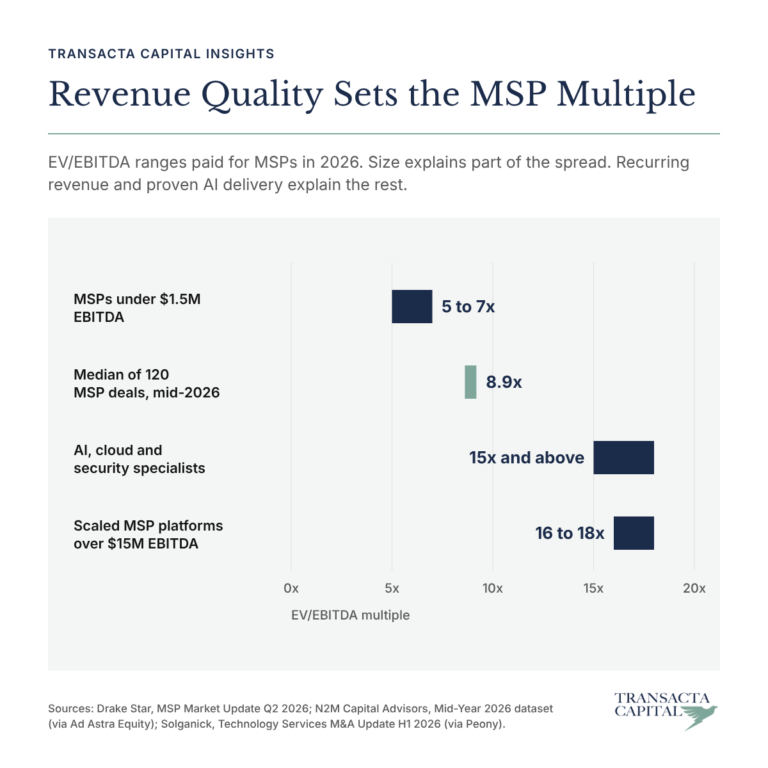
Buyers will read your contracts before they read your growth rate. Drake Star’s tiers show the spread: MSPs below $1.5 million EBITDA trade at 5 to 7x, while scaled platforms above $15 million EBITDA with strong recurring revenue reach 16 to 18x. N2M’s mid-year 2026 dataset of 120 MSP deals puts the median at 8.9x. Size explains part of that gap. Revenue quality explains the rest, and you can change revenue quality in 12 to 24 months. Start here:
- Measure cost per outcome. Know your fully loaded cost per resolved ticket, completed migration or processed transaction, including failed attempts and human review. Buyers will ask, and few sellers can answer.
- Convert your top ten clients first. Move them from hours or FTEs to a base fee plus a volume or outcome component. Ten converted contracts with a year of history are evidence. A pricing deck is a claim.
- Report AI delivery margin separately. Show gross margin on AI-delivered work after inference, tooling and review. If it beats your hourly margin, that difference is the strongest number in your data room.
- Write outcomes into contracts. Define a resolution, a hand-off to a human, a cap on agent spend and the reporting cadence. Loose definitions become credits and disputes after close.
- Fix your per-user exposure. For MSP contracts, add a platform or per-endpoint floor so revenue holds when client headcount falls.
- Build the governance offer. Agent cost caps, approvals and audit trails are what clients lack and what buyers see as defensible revenue.
- Expect margin to dip during the change. Teamwork’s write-up of TSIA World 2026 warns that building cost-per-outcome visibility costs margin before it pays back. Plan the timing so the dip sits behind you when you go to market.
If you plan to buy: the arbitrage sits in the billing model
For acquirers building IT services and MSP platforms, the opportunity is specific. Many founder-led firms have strong delivery teams, long client relationships and clean operations, and still bill by the hour or by the head. Those firms trade at the lower end of the range. A buyer that brings the pricing discipline, AI tooling and governance to convert their contracts can buy at effort-based multiples and grow into outcome-based economics.
The risk is execution. Outcome contracts are harder to underwrite than hourly ones, the margin dips before it rises, and client relationships built on hourly trust can strain when the commercial model changes. We increasingly see earn-outs tied to outcome or recurring-revenue metrics in place of headcount or billable-hour targets, which shares that risk between buyer and seller.
The questions below are the ones we see buyers ask in our mandates. Sellers should have the answers ready before the first meeting.
What to watch in 2027
Three signals will tell IT services founders how fast this moves. First, whether ServiceNow’s consumption revenue shows clearly in 2027, as management expects; if it does, a base fee plus a meter becomes the default commercial model for clients too. Second, whether frontier model prices keep falling. Sunil was deliberately provocative when he said commoditization of frontier models will drive equilibrium, and if he is right, outcome contracts get safer for the firms delivering them. Third, whether agent governance becomes a category clients budget for, which would give MSPs and IT services firms the cleanest new revenue line of the decade.
Every IT services founder we speak with is choosing between two kinds of pain. Reprice now, accept a margin dip and carry delivery risk you have never had to underwrite. Or keep billing effort or by headcount, and watch each AI improvement show up as a smaller invoice and a lower multiple. Cognizant has already moved more than half its revenue. Your buyer will ask which path you chose, and the answer will be in your contracts.

About the author and contributors
Harjit Singh is Founder and CEO of Transacta Capital, a buy-side M&A advisory firm in New York. Transacta advises family offices and technology-enabled businesses with $10 million to $500 million in revenue on acquiring companies with $2 million or more in EBITDA, focused on MSPs and IT services firms in the US, India, the Philippines and Latin America. He was SVP Corporate Strategy at KiwiTech, is a Strategic Advisor to TigerBridge Capital, served on the board of TiE New York, and sits on the Aspiritech Advisory Board. He holds FINRA Series 7, 24, 63 and 79 licences.
Vivek Chopra is Chairman of Mastek Inc. and a Mastek board member, Strategic Board Advisor to CygnusAlpha (the governance and control layer for running agentic AI in production), Strategic Advisor to LumenData and Transacta Capital, and Vice Chair of the Board of Aspiritech. In more than 40 years he has held senior roles at Wipro, Aditi Technologies, IBM, CSC, L&T Infotech and HPE, served on boards including L&T Infotech, Aditi Technologies, Mindcrest and Knolskape, and sat on senior executive councils at Wipro, CSC and IBM. He is on GLG’s Global Advisory Council and is a Limited Partner at Inventus Capital Partners. He holds a B.Tech from IIT Delhi and completed Kellogg’s Advanced Management Program.
Sunil Misra is Executive Chairman of Bridgenext, a digital engineering, data and infrastructure consultancy that recently acquired CloudX and its 300-plus engineers. He is Managing Director of RJN International, LLC a family investment vehicle. He is a member of the Forbes Technology Council. Sunil has also served on several private and public boards and as an advisor to several technology firms. He has built and turned around technology businesses organically and through M&A, and set up delivery networks in more than 30 countries across software, consulting, systems integration and IT, application and business process outsourcing. He holds a BS in Electrical Engineering from IIT Delhi, completed executive education in strategy and AI/ML at MIT, and has been interviewed by Business Week, Fortune, CNBC, CBS, Bloomberg and the Associated Press.
Sources
- Teamwork, Insights from TSIA World 2026: https://www.teamwork.com/blog/tsia-world-2026-insights/
- Zerodha, India’s largest IT firms: https://tradingqna.com/t/fresh-year-no-fresh-start-for-india-s-largest-it-firms/196431; Upstox, Will AI deflation wipe out $10 billion from India’s IT industry?: https://upstox.com/news/upstox-originals/investing/will-ai-deflation-wipe-out-10-billion-from-india-s-it-industry/article-194265/ and IT companies pivot to outcome-based pricing: https://upstox.com/news/market-news/stocks/it-companies-pivot-to-outcome-based-pricing-model-will-it-be-rewarding-and-who-stands-to-gain-first/article-198088/; News Arena, Indian IT faces AI reset: https://newsarenaindia.com/economy/indian-it-faces-ai-reset-as-top-firms-post-mixed-fy26/75733
- Petronella Technology, Managed IT services pricing 2026: https://petronellatech.com/blog/managed-it-services-pricing-guide-2026-what-you-should-actually-pay; Business of Tech, Per-user pricing under strain: https://businessof.tech/podcast/per-user-pricing-under-strain-rich-freeman-explains-the-ai-impact-for-msp-operators/
- EY, IT services M&A in H1 2026: https://www.ey.com/en_in/newsroom/2026/08/it-services-m-a-records-449-deals-worth-us-dollor-14-point-8-billion-in-h1-2026-as-ai-reshapes-buyer-priorities; Drake Star, MSP Market Update Q2 2026: https://www.drakestar.com/news/msp-market-update-q2-2026; Peony, MSP valuation tiers: https://www.peony.ink/blog/best-it-services-msp-ma-advisors; Ad Astra, MSP multiples: https://www.adastraequity.com/ebitda-multiples/it-services-company
- ServiceNow, Q3 2026 results, Form 8-K: https://www.sec.gov/Archives/edgar/data/0001373715/000137371526000092/erq3fy26.htm; Trefis, What is behind the move in ServiceNow stock?: https://www.trefis.com/stock/now/articles/621573/what-is-behind-the-move-in-servicenow-stock/2026-10-30; TradingKey, ServiceNow Q3 2026 earnings call: https://www.tradingkey.com/news/transcripts/262249602-tradingkey
- Futurum, The Pricing Split: https://futurumgroup.com/wp-content/uploads/2026/08/The-Pricing-Split-Why-Core-Software-and-AI-Cant-Share-One-Commercial-Model_AIOKK202608.pdf; BCG, Rethinking B2B Software Pricing in the Era of AI: https://bcg.com/publications/2025/rethinking-b2b-software-pricing-in-the-era-of-ai
- Pulse, ZDNet on agent token use: https://www.pulse.bot/ai/news/what-youll-pay-for-ai-agents-will-be-wildly-variable-and-unpredictable-cdb65703-44b0-45c0-9988-dc1144417351/; WebProNews, FinOps Foundation findings: https://www.webpronews.com/the-ai-reckoning-why-token-bills-are-crushing-enterprise-budgets/; Gartner, 40% of agentic AI projects to be canceled by 2027: https://www.gartner.com/en/newsroom/press-releases/2025-06-25-gartner-predicts-over-40-percent-of-agentic-ai-projects-will-be-canceled-by-end-of-2027; Entrepreneur, Klarna hires humans again: https://www.entrepreneur.com/business-news/klarna-ceo-reverses-course-by-hiring-more-humans-not-ai/
- Pzena, Accenture, Cognizant, Globant: https://www.pzena.com/wp-content/uploads/2026/07/pzenanewsletter-highlighted-holding-2q26_stamped.pdf; Sharekhan, Mastek filings: https://www.sharekhan.com/stock/mastek-ltd/overview
- Sequoia Capital, Julien Bek, Services: The New Software: https://sequoiacap.com/article/services-the-new-software/; Bain & Company, $100 billion agentic AI opportunity: https://www.grundycountyherald.com/?p=101047
- Salesforce, Agreement to acquire Fin: https://investor.salesforce.com/news/news-details/2026/Salesforce-Signs-Definitive-Agreement-to-Acquire-Fin/; Sacra, Intercom Fin pricing: https://sacra.com/chat/h/a419a844-b238-4e9d-94c0-bae80585618f/; Drag, Salesforce buys Fin: https://www.dragapp.com/blog/salesforce-buys-fin/
- The Next Web, Pax8 SMB AI Pulse: https://thenextweb.com/news/shadow-ai-small-businesses-pax8-survey; ai2.work, MIT NANDA findings: https://ai2.work/blog/why-a-third-of-companies-now-build-software-instead-of-buying